



Odisha Advances ₹39,383 Crore Industrial Projects Across 14 Districts, Eyes 42,512 Jobs
 Editor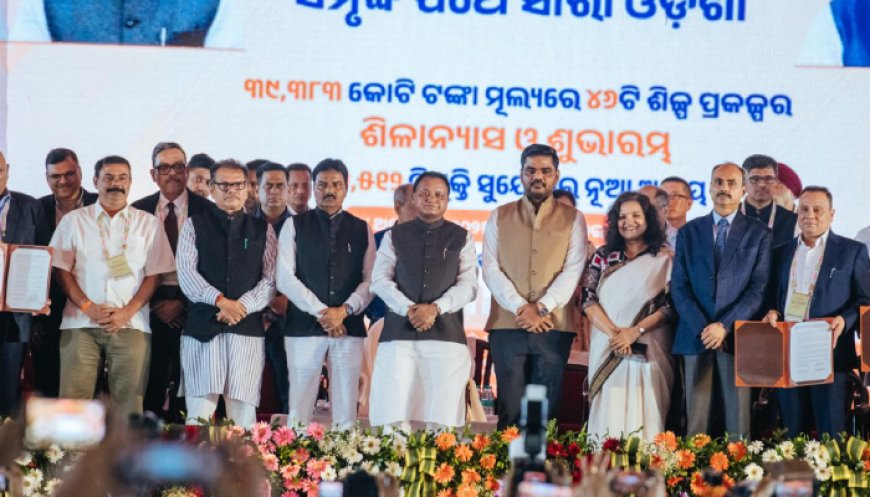
At Kalinganagar, the state inaugurated industrial facilities and launched new projects spanning steel, renewable energy, textiles, IT, food processing and tourism, reinforcing its focus on converting investment commitments into economic growth.
Chief Minister Mohan Charan Majhi, who attended the ceremony on October 14, called for faster project execution, stronger local supply chains and greater employment opportunities for the state’s youth. More than 20,000 people reportedly attended the event, which brought together government representatives and industry leaders.
The projects span steel and downstream manufacturing, ferro alloys, industrial gases, chemicals, textiles and apparel, renewable energy equipment, biofuels, food processing, electronics, IT and IT-enabled services, logistics, shipbuilding, healthcare and tourism. Major companies associated with the programme include Jindal Stainless, Tata Steel, Linde India, Indian Metals and Ferro Alloys (IMFA), Dalmia Bharat Refractories, Luminous Power Technologies and Paradeep Phosphates.
Steel and metals remain central to the investment programme, but the range of projects signals an effort to diversify Odisha’s industrial economy. Investments in IT and electronics, apparel, food processing, tourism and renewable energy could broaden the state’s employment base and create opportunities for micro, small and medium enterprises (MSMEs), local suppliers and service providers.
Alongside the 53 projects, the state announced a further pipeline of 14 investment proposals—12 memorandum of understanding (MoU) projects and two Investment Intent proposals—representing ₹4,805.66 crore in proposed investment and an estimated 9,170 jobs.
“What we commit, we complete. We are moving from MoUs to reality, from intent to investment, and from investment to production,” said Mohan Charan Majhi, Chief Minister of Odisha.
Majhi stressed that industrial growth must translate into factories, production and employment, with opportunities reaching communities across districts. He also highlighted the importance of local procurement, vendor development and industry-ready skills to help young people find work closer to home and support reverse migration.
Industries Minister Sampad Chandra Swain reiterated the government’s focus on moving from investment commitments to implementation, while Minister for Cooperation, Handlooms, Textiles and Handicrafts Pradeep Balasamanta highlighted the employment potential of textile and apparel projects, particularly for women and young people.
The government’s project facilitation efforts involve the Industries Department, IPICOL, IDCO, district administrations and other departments, with an emphasis on resolving implementation bottlenecks and monitoring project milestones.
The programme included visits to IMFA and Jindal Stainless facilities, where the Chief Minister inaugurated a blast furnace at Jindal Stainless and interacted with employees and industry partners.
The scale of the announced investments is significant, but their long-term impact will depend on timely execution, commissioning and the realisation of projected employment. For Odisha, the next challenge is to ensure that the projects deliver not just capital investment, but durable jobs, stronger local supply chains and more balanced regional development under its Samruddha Odisha 2036 vision.